Yoga Nidra and Sound Bath: How They Work Together
Updated September 29, 2026
432Hz vs 440Hz is a question of tuning: both are reference pitches for the note A, and 440Hz is the international standard. A few small studies found 432Hz music lowered heart rate or cortisol slightly more than 440Hz, but none prove it's better for health. The crystal bowls at Carried Sound are tuned to 432Hz for their sound, not as a medical claim.
432Hz is a tuning choice, not a treatment. The research is interesting, early and small.
What is the difference between 432Hz and 440Hz?
The difference is 8 vibrations per second on the note A. Tuned to 440Hz, the A above middle C vibrates 440 times per second. Tuned to 432Hz, it vibrates 432 times per second.
Hz, short for hertz, just means cycles per second. When you change the reference A, every other note shifts with it. So 432Hz tuning lowers the whole scale by the same small amount.
How small? About 32 cents. A cent is one hundredth of a semitone, the step between two neighboring piano keys. So 432Hz sits roughly one third of a semitone below standard pitch. That's enough for many people to notice when the two are played back to back, but not a different note.
| Detail | 440Hz | 432Hz |
|---|---|---|
| What it is | International standard pitch for A | An alternative reference pitch for A |
| Where you hear it | Most recorded music, pianos, tuners and orchestras | Some crystal bowls, some musicians' recordings |
| Difference | — | About 32 cents lower (one third of a semitone) |
| How it's described | Brighter, familiar | Many listeners describe it as softer or warmer |
What happens to the other notes?
Every note moves down by the same proportion. Here's how three common notes compare in the two tunings, rounded to one decimal:
| Note | At A = 440Hz | At A = 432Hz |
|---|---|---|
| Middle C (C4) | 261.6Hz | 256.9Hz |
| E4 | 329.6Hz | 323.6Hz |
| G4 | 392.0Hz | 384.9Hz |
So a crystal bowl labeled "C" will ring at a slightly different frequency depending on which reference it was tuned to.
Why is 440Hz the standard tuning?
440Hz is the standard because musicians needed one shared reference so instruments could play together. The International Organization for Standardization sets A at 440Hz in ISO 16, "Standard tuning frequency", published in 1975 and last confirmed in 2022.
Before a shared standard, pitch varied from city to city and orchestra to orchestra. A standard means a piano in Kansas City and a violin in Vienna can play in tune with each other. That's a practical agreement, not a claim that 440Hz is better for the body. The same logic applies to 432Hz. It's a different agreement, used by some musicians and many crystal bowl makers.
You'll find many bold claims online about 432Hz. Most aren't supported by published studies, and I don't repeat them here. What follows is what the research actually tested.
What does the research say about 432Hz?
Three small studies have compared music tuned to 432Hz with music tuned to 440Hz. Each found a modest difference in favor of 432Hz on at least one measure.
| Study | Who and how | What they found |
|---|---|---|
| Calamassi & Pomponi, 2019 · Explore | 33 healthy adults · double-blind cross-over · 20 minutes of film soundtracks at each tuning | Heart rate dropped about 4.8 beats per minute more at 432Hz. Blood pressure and breathing rate dipped slightly, but not significantly. Listeners reported more focus and satisfaction at 432Hz. |
| Calamassi et al., 2020 · Acta Biomedica | 12 patients in a spinal cord injury unit · double-blind cross-over pilot | Self-reported sleep scores improved at 432Hz and not at 440Hz. Stress dropped at both tunings, but not significantly. |
| Aravena et al., 2020 · Journal of Applied Oral Science | 42 dental patients before tooth extraction · randomized · 432Hz music, 440Hz music or no music | Both music groups had much lower dental anxiety scores than the no-music group, with almost no difference between them. Salivary cortisol was lowest in the 432Hz group. |
What "double-blind cross-over" means
Two of the studies used a double-blind cross-over design. Each participant heard both tunings, on different occasions, so each person served as their own comparison. Double-blind means neither the listeners nor the researchers running the sessions knew which tuning was playing. That design reduces bias, which is a strength. It doesn't fix the problem of small numbers.
Taken together, these studies suggest 432Hz music may have a small calming edge over 440Hz music on some measures, in some settings. All three sets of authors call for larger trials before drawing firm conclusions.
What doesn't the research show?
The research doesn't show that 432Hz heals, treats or prevents anything. It's too small and too early to support health claims.
Here's why the results need caution:
- Tiny samples. The three studies had 12, 33 and 42 participants. Small studies can find effects that disappear in larger ones.
- Pilot designs. Two are labeled pilot studies. They're meant to test whether a bigger trial is worth running, not to settle the question.
- Recorded music, not sound baths. All three used recorded music. None tested live singing bowls, so their results don't transfer directly to a sound bath.
- Short-term measures. Heart rate, cortisol and sleep scores were measured around the listening sessions. No study tracked lasting effects.
- Music mattered more than tuning. In the dental study, anxiety dropped about the same with either tuning. The biggest difference was between music and no music at all.
What would stronger evidence look like?
To show that 432Hz tuning itself makes a real difference, researchers would need larger randomized trials with hundreds of people, run at more than one site. Ideally, they'd test live instruments as well as recordings, and follow people for weeks, not minutes. Until then, the honest summary is "promising but unproven."
That last point is worth holding onto. If you enjoy a sound bath, the most likely reasons are simple: an hour of quiet, lying down, and sound you find pleasant. The exact tuning is one small part of that.
A sound bath is a guided hour of rest. It isn't medical or mental health treatment, and it doesn't replace either.
Why are Carried Sound's bowls tuned to 432Hz?
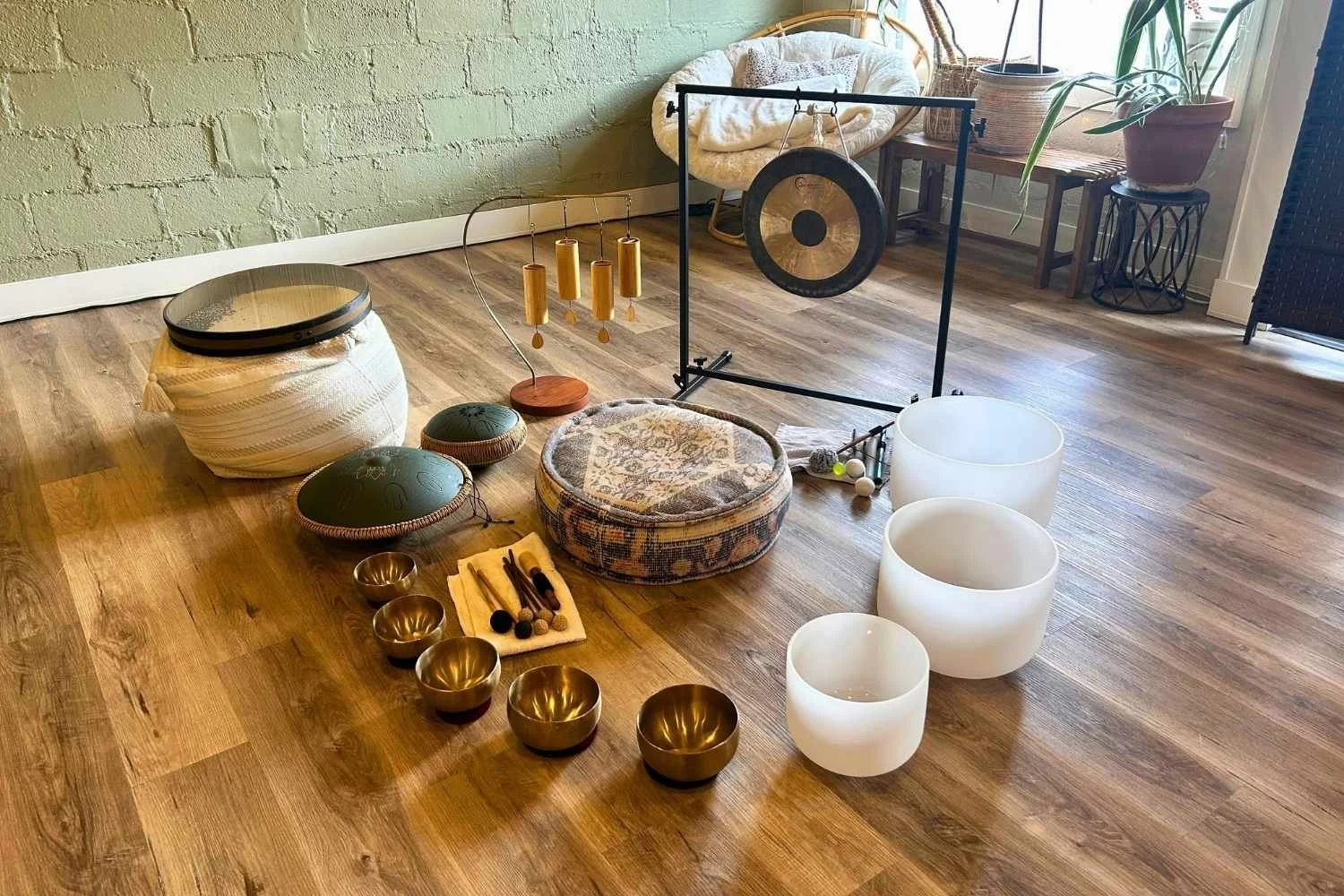
The quartz crystal singing bowls at Carried Sound are tuned to 432Hz because of how they sound, not because of health claims. Many listeners find the tuning softer, and a set tuned to the same reference blends cleanly when the bowls ring together.
My own reason is simple. 432Hz crystal bowls are widely used and easy to find, and I like the slightly lower pitch. I'm drawn to a softer, warmer sound, and this tuning gives me that.
If you shop for crystal singing bowls, sellers usually list both the note and the reference tuning, for example "C, 432Hz." That detail matters when you build a set. Bowls tuned to different references can sound slightly out of tune with each other when played together.
Crystal bowls are tuned when they're made, so the tuning is fixed for the life of the bowl. The rest of the set, including Himalayan bronze singing bowls and chimes, adds warmer, less exact tones around them.
Every session is led by Joann Schermerhorn, an ISTA Certified Therapeutic Sound Practitioner and a Sound Healing Arts Facilitator and Educator (200 hours, The Sound Medicine Academy).
Can you hear the difference?
Most people can hear the difference side by side, but not on its own. Played back to back, a one-third-semitone shift is noticeable to many listeners. Heard alone, one tuning just sounds like music, unless you have perfect pitch, which is rare.
In a sound bath, you won't hear a 440Hz version for comparison. What you'll notice instead is the overall character of the sound: how the bowls blend, how long they ring and how the room feels.
So is 432Hz better?
For health, there isn't strong evidence either way yet. For listening, it comes down to taste. Some people prefer the softer feel of 432Hz. Others can't tell or don't care. Both are valid.
Want to test your own ear? Many free tuner apps let you set the reference pitch. Play an A at 440Hz, then at 432Hz, a few times back to back. Notice which one you prefer, if either.
For me, 432Hz bowls feel more meditative. I find myself more drawn into the notes. That's my experience as a player and listener, not something the studies measured.
The easiest way to decide how you feel about 432Hz is to hear it live. You can join the Wednesday sound bath in Overland Park for $25, or book a sound bath for your group at your home or venue, from $275 for 1–4 people.