What to Expect at Your First Sound Bath: A Nervous-System-Safe Guide for Beginners
Updated September 29, 2026
Here's what to expect at your first sound bath: you arrive, settle onto a mat and let a guided yoga nidra lead you into rest. Live singing bowls and chimes play under the voice, then on their own, before a slow return. No experience is needed. The Wednesday Open Session in Overland Park runs 5:30–6:30 pm for $25.
You don't have to be calm when you walk in. The first part of the hour is there to help you get there.
What happens when you arrive?
You check in, choose a spot and set up your mat, bolster and blanket. It takes a few minutes, and you don't need to know anything beforehand.
The Wednesday Open Session is at Very Well KC, 7905 Santa Fe Dr, Overland Park, KS 66204. You reserve your spot on Vagaro ahead of time. Mats, bolsters and blankets are provided, so you can arrive with nothing but comfortable clothes.
Most people walk in still carrying their day. They've come from work, traffic or a busy afternoon, and it takes a little time to land. That's expected. I don't ask anyone to arrive relaxed.
A few tips for setting up:
- Arrive a few minutes early. You'll have time to settle before the room goes quiet.
- Use the bolster. Many people like it under their knees. Try it and move it if it doesn't feel right.
- Keep the blanket close. Lying still for an hour, some people start to feel cool partway through.
- Silence your phone before you lie down.
Sound bath etiquette, in short
There aren't many rules. Most of them come down to protecting everyone's rest:
- Keep voices low once you're in the room.
- Put your phone away, not just on vibrate.
- Save conversation for after the session.
- If you need to leave early, go quietly. That's fine.
- Coughing, sneezing and shifting are normal. Nobody expects you to stay perfectly still.
What happens during the hour, step by step?
The whole hour is a guided yoga nidra, with live singing bowls and chimes under the voice, a stretch of sound on its own and a slow return. Here's how it unfolds on a Wednesday:
- Settling in (5:30 pm). Yoga nidra begins the moment you lie down. I start with guided breathing: slow, deep breaths down into the belly. I invite everyone to stay with this room and this moment. When a thought pulls you somewhere else, you let it pass and come back to your breath.
- Permission to move. Before we go further, I let everyone know they can shift, change positions, open their eyes, sit up or step out at any time. There's no right way to lie there.
- Intention. Early on, you set a sankalpa: a short, positive intention in your own words. You keep it to yourself.
- Guided yoga nidra with sound. My voice guides your attention through the body and breath. You don't need to do anything but listen. Underneath, I play crystal and Himalayan bronze singing bowls and chimes softly.
- Sound alone. Near the end, my voice drops away. For a stretch, it's just the bowls and chimes.
- Slow return (6:30 pm). I guide you out the way a yoga class ends savasana, the final resting pose: small movements first, then rolling to one side and slowly sitting up. Then you gather your things at your own pace.
What does it sound like?
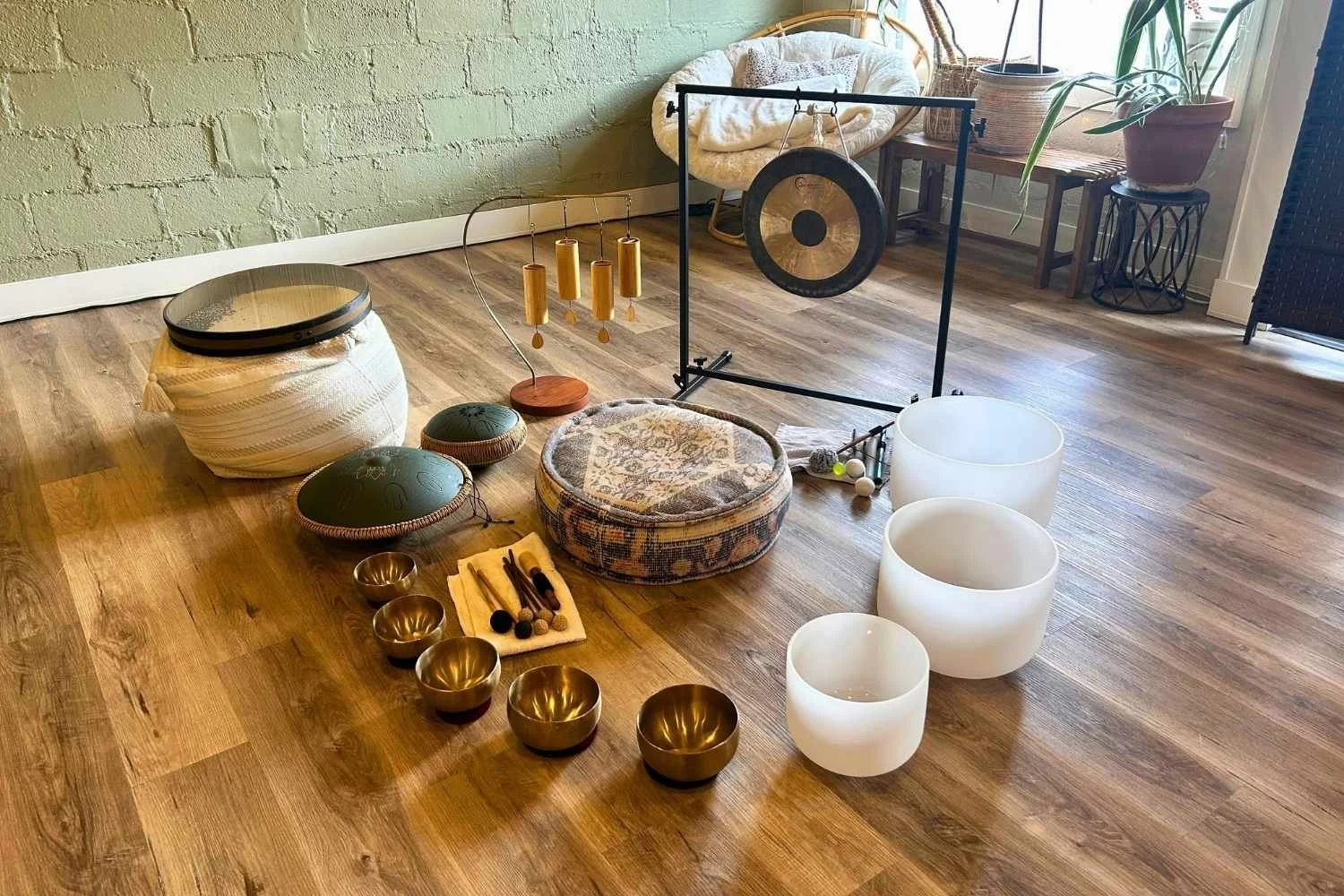
On Wednesdays, I play singing bowls and chimes. Each has its own voice, and they layer together:
- Crystal singing bowls: clear, sustained tones that hang in the air.
- Himalayan bronze singing bowls: warmer, with more texture and overtones.
- Koshi chimes: light, airy notes that drift in and out.
- Large standing chimes: longer tones that ring out and fade slowly.
For private events and corporate sessions, I often bring a larger set that also includes a Chau gong, a wave drum and a tongue drum. I always play them gently, with everyone's nervous system in mind.
If lying flat isn't comfortable, rest on your side or sit up. You'll hear the same sound either way.
The crystal bowls are tuned to 432Hz, a tuning many listeners find softer. If you're curious, here's why the bowls are tuned to 432Hz.
Every session is led by Joann Schermerhorn, an ISTA Certified Therapeutic Sound Practitioner and a Sound Healing Arts Facilitator and Educator (200 hours, The Sound Medicine Academy). You can meet your sound practitioner before you come.
What might you feel during and after?
Many people feel their body get heavier and their mind get quieter once the sound begins. Everyone's hour is different, though, and there's no feeling you're supposed to have.
During the session, people often notice some of these:
- Their body feels heavy or sinks into the mat
- The lower bowl tones feel like something you sense in the body, not just hear
- Time passes faster than expected
- They drift in and out, or fall asleep
- Thoughts come and go, or an emotion rises and passes
From where I sit, the change is often visible. During the opening breath, shoulders start to drop. Once I start playing, a lot of people settle further, and the room gets still.
After the session, many people leave feeling calmer. Some feel a little slow or groggy, the way you do after a nap. Take a minute before you drive, and drink some water.
Here are a few things people have said to me after a session, in their own words:
- "I never felt so relaxed."
- "That was transportive."
- "You took me on a journey."
- "I was able to have a visualization meditation."
- "One of the notes from your bowls was piercing into my heart, in a good way."
No two people describe it the same way, and your first time may feel different from all of these.
A sound bath is a guided hour of rest. It isn't medical or mental health treatment, and it doesn't replace either.
What should you wear and bring?
Wear soft clothes you can lie down in, plus socks or a layer. For a Wednesday session, that's all you need to bring.
Skip anything tight at the waist, and leave bulky jewelry or hair clips at home if they'd press into the mat. A water bottle is a good idea for afterward. If you like something over your eyes, bring an eye pillow or a soft scarf.
For more on choosing a session, costs and common first-timer worries, see the beginner's guide to sound baths.
Can you book something more private?
Yes. A private sound bath for 1–4 people is $275, at your home, at a venue you choose or in the Very Well KC studio. Larger groups are priced by size, up to 40 people.
| Group size | Price |
|---|---|
| 1–4 people | $275 |
| 5–10 people | $450 |
| 11–20 people | $675 |
| 21–40 people | $900 |
| 40+ or multi-session | Quote |
Private sessions run 60–75 minutes and include all instruments, setup and pack-out. Travel is included within 20 miles of Overland Park. It's a good fit if you'd rather try your first sound bath with a partner, a few friends or family, or if a shared room feels like too much for a first time. You can book a sound bath for your group and choose the date.
Who should talk to a provider first?
Anyone with epilepsy, a pregnancy, a pacemaker or other implanted device, severe sound sensitivity or a history of trauma should check with their healthcare provider and tell Joann before booking.
For everyone else, there's nothing to prepare. Reserve a mat, wear something comfortable and give yourself the hour. You can drop in on a Wednesday any week.