What Is a Sound Bath? A Plain-Language Guide
Updated September 29, 2026
A sound bath is a guided hour of rest where you lie down and listen to live instruments. Crystal and bronze singing bowls, chimes and sometimes a gong ring around you for about 60 minutes. There's no water involved, and no experience is needed. You're "bathed" in sound, not water.
You don't do anything in a sound bath. You lie down, listen and let the sound do the moving.
Why is it called a sound bath?
The name describes the feeling, not a tub. In a bath, water surrounds you on every side. In a sound bath, the tones of the bowls and chimes fill the room and surround you the same way. You're immersed in sound while you rest.
How long is a sound bath?
Many sound baths last about an hour. At Carried Sound, the Wednesday Open Session and corporate sessions run 60 minutes, and private and group sessions run 60–75 minutes. Longer retreats weave several sound baths into a half day, full day or weekend.
What happens during a sound bath?
You lie down, get comfortable and listen while a practitioner plays live instruments for about an hour. Most sound baths follow a simple arc:
- Settle in. You lie on a mat with a bolster and blanket, or sit in a chair.
- Guided start. Many practitioners open with breathing or a guided practice like yoga nidra to help the room slow down.
- Live sound. The instruments rise and fall around you. Some sound baths include spoken guidance over the sound, and some are sound only.
- Quiet return. The sound fades, and you're guided back to the room at your own pace.
At Carried Sound's Wednesday Open Session, the whole hour is a guided yoga nidra, with singing bowls and chimes played under my voice. Near the end, my voice drops away and the bowls and chimes play on their own. For a step-by-step walkthrough of that hour, read what to expect at your first sound bath.
Before the first strike, I watch how people are settling in. I notice who's fidgeting and who's already zonked out. I look at how everyone is breathing: shallow, or deeper into the belly. Once I start the opening breathwork, I listen for deep sighs, especially the ones that come naturally and not just from my prompts. That's how I know the room is starting to settle.
What instruments are used in a sound bath?
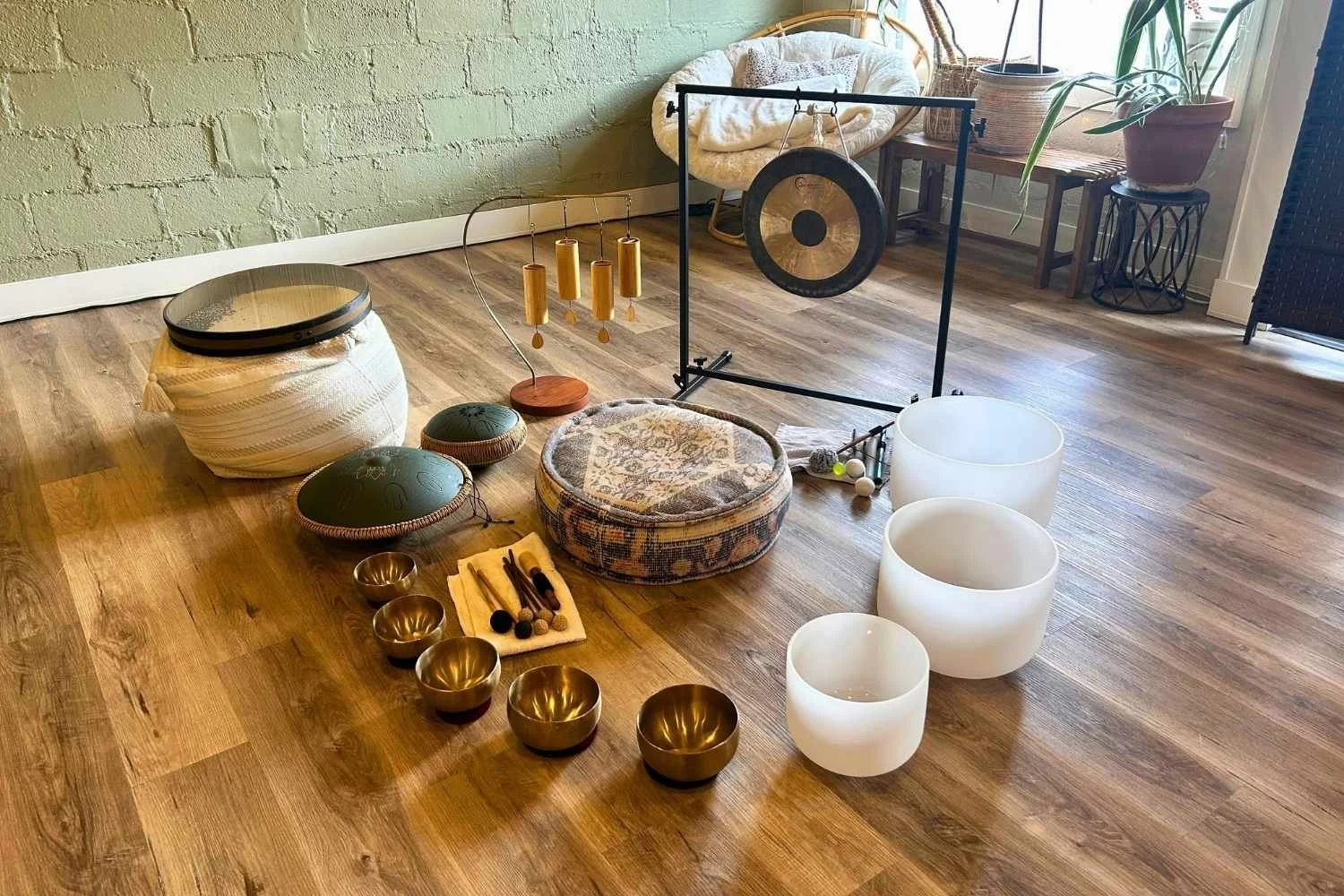
Most sound baths use singing bowls and chimes, and many add a gong or drums. Each instrument brings a different kind of tone, and the practitioner layers them.
| Instrument | What it is | How it sounds |
|---|---|---|
| Quartz crystal singing bowls | Frosted bowls made from quartz, each tuned to one note | Clear, pure tones that hang in the air |
| Himalayan bronze singing bowls | Metal bowls, often hand-hammered | Warmer, with layered overtones |
| Koshi chimes | Small wind chimes, each tuned to a set of notes | Light, airy and gentle |
| Large standing chimes | Longer chimes hung on a stand | Longer tones that ring out and fade slowly |
| Gong | A large hanging bronze disc struck with a soft mallet | A deep, rolling wash that swells and fades |
| Wave and tongue drums | A frame drum filled with beads, and a steel drum with tuned tongues | A soft rush like water, and gentle melodic notes |
On Wednesdays, I play crystal and Himalayan singing bowls, Koshi chimes and large standing chimes. There's no gong on Wednesdays.
For private events and corporate sessions, I often bring a larger set that also includes a Chau gong, a wave drum and a tongue drum. I always play them gently, with everyone's nervous system in mind.
My order of instruments changes from session to session. My background is in Ayurveda, so I play with the elements in mind. A typical arc moves through air, fire, earth, fire, water and back to air, and I choose the instruments that suit each element.
The crystal bowls are tuned to 432Hz, a tuning many listeners find softer. Here's why the bowls are tuned to 432Hz, and what the research on it does and doesn't show.
What does a sound bath feel like?
Many people describe it as deeply restful, but everyone's hour is different. There's no feeling you're supposed to have.
During the session, people commonly notice some of these:
- Heaviness. The body feels like it sinks into the mat.
- Vibration. Lower tones feel like something you sense in your body, not just hear.
- Drifting. Your mind wanders, comes back, and wanders again.
- A changed sense of time. The hour often feels shorter than it is.
- Sleep. Some people fall asleep. That's still rest.
- Emotion. Occasionally a feeling or memory rises and passes.
Afterward, many people leave feeling calmer. Some feel slow for a few minutes, like after a nap. It helps to sit for a moment before you drive.
A sound bath is a guided hour of rest. It isn't medical or mental health treatment, and it doesn't replace either.
How is a sound bath different from meditation?
In meditation, you usually direct your own attention. In a sound bath, the sound gives your attention somewhere to rest, so there's less to do.
| Detail | Silent meditation | Guided meditation | Sound bath |
|---|---|---|---|
| What guides you | You do | A voice | Live instruments, sometimes with a voice |
| What you do | Focus on the breath or a word | Follow instructions | Lie down and listen |
| Typical position | Seated | Seated or lying down | Lying down, or seated |
| Good fit if you | Like quiet and practice | Like clear direction | Find silence hard, or want to fully let go |
That's why many people who "can't meditate" do well in a sound bath. You don't have to quiet your mind. You just keep returning to the sound.
Many sound baths also borrow from meditation. Carried Sound's Wednesday session pairs sound with yoga nidra, a guided rest practice. You can read how that works in the yoga nidra sound bath guide.
Is a sound bath the same as sound healing?
Not quite. "Sound healing" is a broad umbrella term people use for many practices involving sound and wellbeing. A sound bath is one specific format: a live listening session, usually in a group, where you rest while instruments are played. At Carried Sound, sound baths are offered for relaxation and rest, not as a treatment.
Who should check with a provider before a sound bath?
Anyone with epilepsy, a pregnancy, a pacemaker or other implanted device, severe sound sensitivity or a history of trauma should check with their healthcare provider and tell Joann before booking.
For almost everyone else, there's nothing to prepare. No belief or experience needed. You just lie down and listen. You're always free to shift, change positions, open your eyes, sit up or step out.
Where can you try a sound bath in Overland Park?
The simplest way is the Wednesday Open Session at Very Well KC, 7905 Santa Fe Dr, Overland Park, KS. It runs every Wednesday, 5:30–6:30 pm, for $25 per person. It's a live sound bath with guided yoga nidra, and mats, bolsters and blankets are provided. You reserve on Vagaro.
If you'd rather have a session just for your people, you can book a sound bath for your group at your home, a venue or the Very Well KC studio. Private and group sessions start at $275 for 1–4 people. Corporate sessions for teams start at $650.
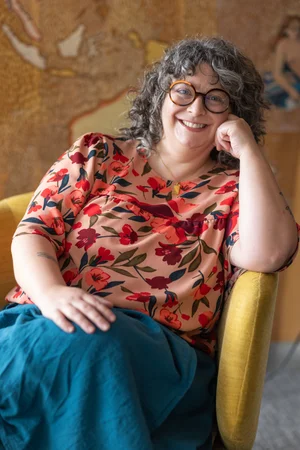
Every session is led by Joann Schermerhorn, an ISTA Certified Therapeutic Sound Practitioner and a Sound Healing Arts Facilitator and Educator (200 hours, The Sound Medicine Academy). You can meet your sound practitioner, or come try the Wednesday sound bath in Overland Park any week.